
Fan Service in RTD2's Doctor Who
Some successful, and unsuccessful, examples from the recent era of the show.

Warning: Spoilers ahead.
Returning to a topic that Tom and I discussed on the September 1, 2025, episode of Ancient Geeks and that I wrote about here on the substack last week, I want to expand on some passing comments I made about fan service and Russell T. Davies' second stint as showrunner.
As I noted in our earlier episode on Doctor Who, I am a long-term fan, having first encountered Tom Baker as the Doctor via PBS when I was in high school in the mid-1980s. I have been a fan ever since, and RTD will always have my eternal gratitude for reviving the show in 2005 after its time in the wilderness.
I will confess that I am more a Steven Moffat guy than an RTD guy, as I prefer his understanding of the character of the Doctor, as well as his often extremely clever way of approaching a show about time travel.
Having said that, I was thrilled when RTD was announced to be returning to the show after the Chibnall era fell (in my view, although not just my view) a bit flat. One day, I will perhaps flesh all of that out here on the AG Substack, but I will leave all of that as basic background.
My main goal today is to focus on the notion of fan service and RTD2. In this case, I am referring not to the kind of anime-defined fan service that I noted in a previous post (although it occurs to me that Leela and Peri might fit such a discussion), but rather the kind of fan service that leans on a creator giving the fans “what they want” and/or overly relying on nostalgia and call-backs.
I am going to award RTD two clear wins in this category, and then name a number of massive misses.
Fan Service Win #1: Fourteen
I will admit that I am a massive softie when it comes to seeing old Doctors come back to the screen. I have rewatched both “The Five Doctors” and “The Two Doctors” more times than those stories warrant because they are multi-Doctor stories. For the record, “The Day of the Doctor” is the best multi-Doctor story, followed by “The Three Doctors.”
As such, I was prime material for the idea that Thirteen regenerated into David Tennant as the Fourteenth Doctor. Plus, who doesn’t love Tennant? He is clearly a fan himself and has proved to be one of the best ambassadors for the show. And I say this acknowledging that Smith and Capaldi are my favorite Doctors of this era (really, alongside Tom Baker, of any era).
Still, for a 60th-anniversary celebration, and for a limited run, what could be better than such a familiar face with a new twist?
This was clearly nostalgia-driven fan service, and I was there for it. Likewise, doing things like bringing the Star Beast out of the comics to the screen and bringing back the Celestial Toymaker, a villain who hadn’t been seen since the Hartnell days, were likewise there for hardcore fans.
On balance, the three episodes with Fourteen were enjoyable and did rekindle some Whovian magic.
I will say, however, that the fact that the final, dramatic, high-stakes game that the Doctor and the Toymaker played was [checks note], um, catch, was a great illustration of how RTD excels at setup, but frequently is not a good closer (to put it kindly).
So, score one for RTD giving the fans something they wanted.
And, the return of Tennant meant another possible bit of fan service was on the table as well.
Fan Service #2: Belated Justice for Donna Noble
One of the story beats from RTD1 that has long stuck in the collective craw of the Whovian fan base was that Donna Noble, who sits high in the pantheon of companions, was left in a state wherein she did not remember her time with the Doctor. Indeed, if she did, her mind would burn!
Based on interviews I heard at the time of the 60th-anniversary specials, this plot point has been something that fans have hounded RTD over, and was something that he, himself, regretted as a writer. The decision to bring back Tennant meant an opportunity to undo this particular bit of the show’s lore.
This may be one of the purest examples of fan service of this type that I can think of. It was clearly a fan-derived demand that affected a writer, who, in turn, made the demanded change on screen. This was reinforced by the fact that RTD-as-fan was clearly influencing RTD-as-writer/show-runner.
And for me, it worked. And I fully recognize the narrative contrivances and technobabble needed to right this particular narrative wrong.
It also allowed for a rather wonderful, and yes, nostalgic, episode, “Wild Blue Yonder,” which recaptured some of the best magic of Tennant and Catherine Tate from the RTD1 era.
So, here I would again say this was a good use, if not indeed, the best use, of fan service by RTD.
Fan Service 3: Teases and Substance-Free Nostalgia
Having sung RTD’s praises, I am afraid I have to go in the opposite direction for he rest of this post.
Let me provide three names, which more or less demonstrate the worst of fan service: Sutekh, Omega, and the Rani. Like with the Toymaker, these were old-school adversaries that many fans have long wanted to see return (especially, I think, Omega and the Rani, as they are both renegade Time Lords).
Sutekh was the protagonist in the classic 1975 Fourth Doctor serial, “The Pyramids of Mars.” He was the kind of antagonist that really challenged the Doctor, helped magnify and exemplify his heroism.
The idea that RTD was bringing this villain back was exciting to me (and, I think, a lot of other fans). However, at the end of the day (well, of the first season of the Gatwa era at least), Sutekh came back, but mostly as just a CGI thing, not an actual character. Despite higher budgets and far better effects and production values, this confrontation between Fifteen and Sutekh was just frenetic, silly, and rather more anti-climactic than the low-res fight he had with Four.
It was a lot of build-up, with very little payoff, which is RTD’s biggest sin as a general matter. It was evident in RTD1 where the big finales didn’t live up to the buildup. Although I think RTD2 in some ways overpromised even more by offering up these fan service-y possibilities, only to have them end up being so little.
Sutehk, at least, made an extended appearance on screen, even though it was more than a disappointment.
Season two of the Disney+/BBC/Bad Wolf Studios edition of Who teased the return of Omega, a renegade Time Lord from the aforementioned “The Three Doctors,” as well as a Five serial, “The Arc of Infinity.” For all the hyping, Omega ended up a CGI creation as well, and really very much felt like one of South Park’s memberberries. Member Omega? Well, here he kind of is, but then he isn’t.
It made the Sutekh appearance seem like a whole narrative by comparison.
In addition to those misses, amidst both seasons, we were treated to a mysterious character, Mrs. Flood, who ended up being another renegade Time Lord, The Rani (last seen with Seven back in the 1980s). She was mostly a gimmicky running bit until she bigenerated (another new RTD trick) into Archie Panjabi, who was seemingly inspired casting. Panjabi can do menacing, scenery-chewing villainy quite well. Alas, her character was wasted, and only the older, Mrs. Flood version of the Rani seemingly survived.
It all very much felt like “Member the Rani?” and nothing more.
There wasn’t even really an adequate matching of wits between Punjabi’s Rani and Gatwa’s Doctor.
It was an utterly wasted opportunity.
(I won’t even get into the missed opportunity with the Pantheon).
Lessons?
First and foremost, I think what I have identified here is that it is possible to do good fan service by bringing back the classics, done well, and in righting past narrative sins. It is also cool to bring back obscure (the Toymaker) or deep-cut (the Star Beast) in a way that can be fun and satisfying in a way that only a true fan can enjoy, but that a newer fan need not be privy to enjoy.
Second, you have to do it right. You have to have a reason beyond just tickling a memory. Moreover, if you are going to bring back something that long-term fans think they want, then use it as an opportunity to not only tickle some memory, but use it (especially on a show as old as Doctor Who) to entice and excite the newer, current fans.
Part of the problem with the Trelane/Q call-back in season 3 of Strange New Worlds, “Wedding Bell Blues,” is not simply that it was somewhat clunky fan service, but it was also kind of lost on newbie fans and wasn’t a good enough story for it to fully stand on its own. It certainly didn’t use Trelane in a way that new fans were going to be wowed in some way. I would contrast that the season 1 finale of SNW, “A Quality of Mercy,” both had a lot of cool elements for old school fans, but used the older narrative in a way that the story still could hit for newer fans.
As listeners to the podcast know, I like the Easter Eggs and the references. I actually do want decades-old stuff from these long-standing franchises to be mined—but not just to have it dangled in front of me for no new narrative purpose.
Did I want to see Sutekh, Omega, and the Rani return to Doctor Who? Yes, guilty as charged. But not the way it was done, just hanging an “Omega” sign around the neck of a CGI monster and calling it a return, is more disappointing than the character never being mentioned ever again.
Fundamentally, there needs to be a decent story reason for the callback. Thirteen regenerating into Fourteen with the same face as Ten was at least given some interesting story reasons, and even the bigeneration into Gatwa’s Fifteen and his incarnation of the Doctor, finally having gotten past the weight of the Time War, more or less worked.
Fixing Donna’s problem worked.
But having old villains show up in a way that does not at all use the reason the fans liked them in the first place is fan disservice.
I mean, this is Omega’s return and his confrontation with the Doctor after all these years? This is the culmination of the Rani’s return? A narrative disservice, indeed.
I keep pondering what the right about fan service/nostalgia/call backs is, and I keep returning to a fairly simplistic answer: it depends on the quality of the deployment, more than anything else.
Sometimes a past plot or character has more story to mine (see, e.g., Star Trek II: The Wrath of Khan), and sometimes just namechecking a legendary villain amounts to nothing more than a lazy tease.
And Then There is THAT Ending
I almost forgot the cherry, bonus weird fans service from RTD2: the regeneration into Rose(?).
The vague nature of the show’s future, coupled with professional demands on Ncuti Gatwa’s time, led to a weird Hail Mary regeneration scene in which Fifteen appears to regenerate in a Sixteen with Rose Tyler’s face. Why? Because fans liked Rose, I guess?
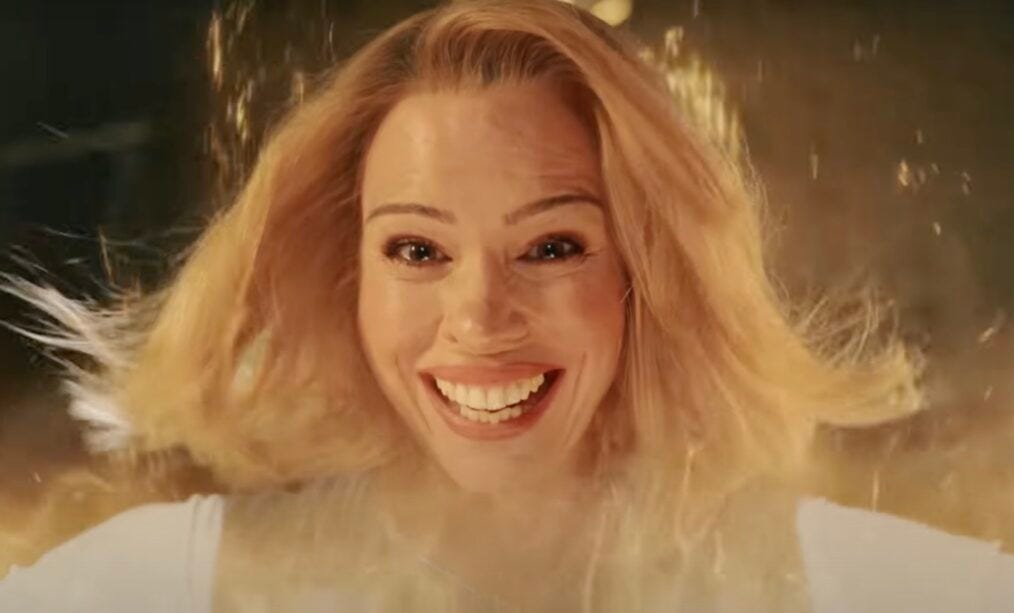
I guess we will see if RTD (or some other showrunner) can figure out what that means and turn what feels like more empty-calorie fan service into a serviceable story.
 | A guest post by
|
I think I stopped watching the show after David Tennet..Tennett...Tennant? (I never remember how to spell it, and I'm too lazy to check.) But to get to your point about reanimating old characters. I mean, it can work, but I feel that quite often, in addition to fan service, it's also just bad writing and lack of creativity.
Yes, I agree that Q, Spock, or even Khan are great characters, but they worked in the context of their contemporaries. Bringing Q to Star Trek: Strange New Worlds feels odd, since Q's role was to challenge Captain Picard and his values, and their relationship developed over the years. Bringing him to a random episode with Pike without any context or plans to utilize him later feels not only silly but futile. If the viewer lacks context, understanding, or deeper knowledge of the universe and its players, it would fall flat. Additionally, these new shows are a product of our time. We have different problems than we had in the 80s, 90s, or even the 2000s. The world is different. Why not create an antagonist who reflects the challenges of our times, instead of the past, then?
My suspicion: bad writing, lack of creativity, and need to make money (banking on nostalgia).